
Mathematics education in the early grades depends on a small number of foundational skills, and multiplication fluency is among the most important of them. A student who cannot recall multiplication facts automatically carries that gap into every subsequent area of mathematics, from long division and fractions to algebra and beyond. Yet despite how much depends on it, multiplication is one of the areas where students most commonly struggle.
The reasons are straightforward. Memorizing one hundred individual facts through repetition alone is tedious, and traditional drills often create anxiety rather than confidence. What students need is not more pressure but better tools used in smarter ways.
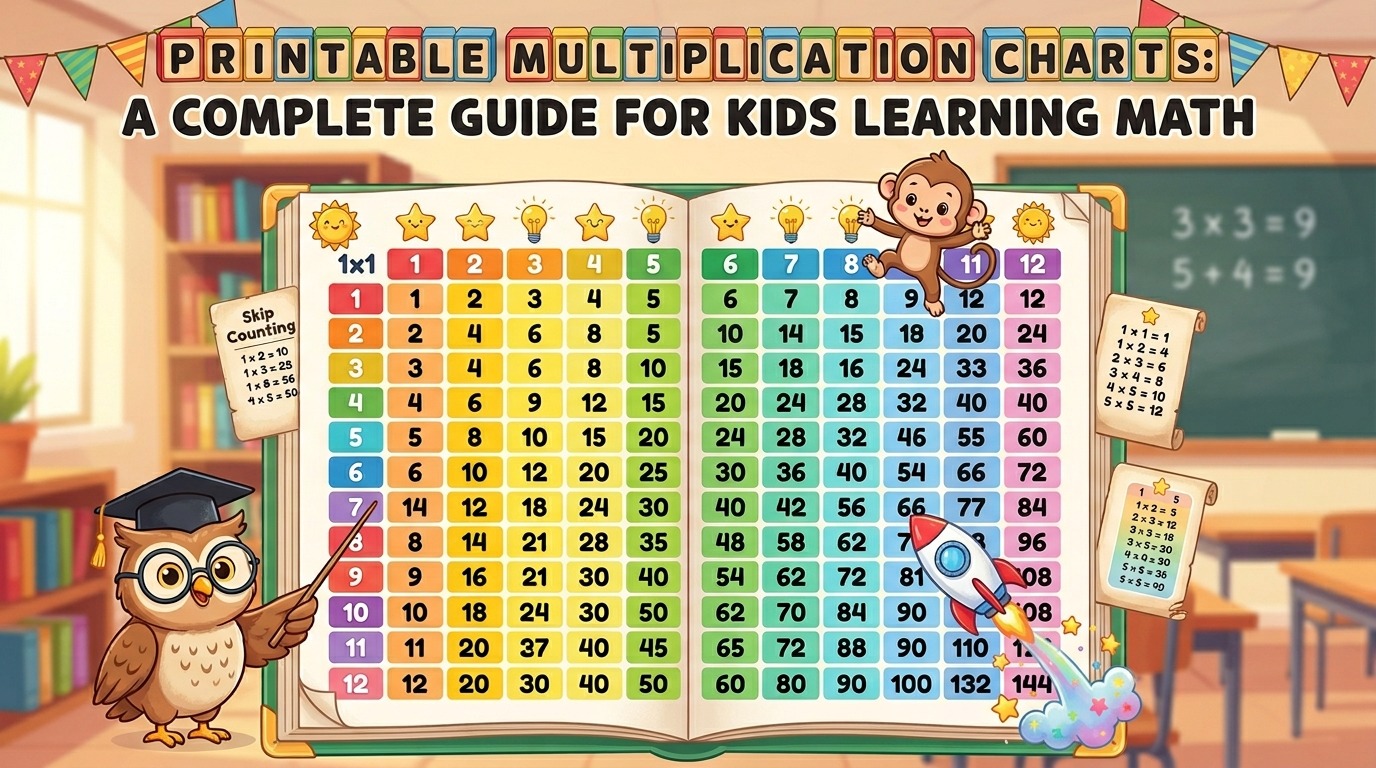
A printable multiplication chart is one of the most effective and most underused tools in elementary mathematics education. When chosen correctly and used with purpose, it accelerates memorization, reveals number patterns, and builds genuine understanding rather than surface recall. This guide explains everything parents and teachers need to know to make printable Multiplication Charts work for the children in their care.
Understanding the Role of a Multiplication Chart in Learning
More Than a Reference Tool
Many adults remember multiplication charts as the laminated sheets hanging at the front of a classroom, consulted when a student forgot an answer. That reference function is real and useful, but it represents only a fraction of what a well-designed chart can do.
A multiplication chart is simultaneously a memory aid, a pattern-discovery tool, and a self-assessment instrument. It provides immediate feedback. It makes invisible mathematical relationships visible. It allows students at different ability levels to engage with the same material at their own pace without frustration.
Research in mathematics education consistently shows that students who understand why multiplication facts are true, rather than simply accepting them, retain those facts more reliably and apply them more flexibly. A chart supports that understanding by making the structure of multiplication visible at a glance.
The Difference Between Filled and Blank Charts
Not all multiplication charts serve the same function, and choosing the wrong type for a given situation undermines the learning process.
A filled chart, one where every product is already printed, serves best as a reference and a passive exposure tool. Hung on a wall or kept inside a binder, it allows repeated visual contact with the facts without any formal practice session required. The brain absorbs patterns through repetition, and a filled chart that a child sees every day gradually becomes familiar territory.
A blank chart, by contrast, is an active practice tool. The student fills in every product from memory, revealing exactly which facts are solid and which require more attention. This honest, immediate feedback is far more valuable than any scored test because it points directly to the specific facts that need work. Rotating between filled and blank charts at different stages of learning produces significantly better outcomes than relying on either type alone.
Choosing the Right Chart for the Child’s Skill Level
Beginning Learners in Grades Two and Three
Young students encountering multiplication for the first time benefit from starting with a limited range. A chart covering one through ten presents fewer facts, creates a less intimidating visual experience, and allows the child to build genuine confidence before expanding. Starting too large is one of the most common mistakes adults make when introducing multiplication tools.
At this stage, the chart functions primarily as a conceptual bridge. The child is learning what multiplication means, how it relates to repeated addition, and why the grid is structured the way it is. Understanding the tool comes before using the tool.
Standard Elementary Range for Grades Three and Four
The one through twelve chart represents the standard curriculum range in most educational systems. It covers every fact a student needs for typical school assessments and provides enough breadth to reveal the major patterns embedded in the multiplication table.
Students at this stage should move from using a filled chart for reference toward using a blank chart for regular practice. A daily routine of filling in a blank chart from memory, checking accuracy against a filled version, and noting which facts required guessing creates a focused, efficient practice loop that most students can complete in under ten minutes.
Advanced Learners Preparing for Pre-Algebra
Students who have mastered the standard range and are preparing for more advanced mathematics benefit from extending to a one through twenty chart. This broader range reinforces the patterns already learned, introduces larger products that will appear in multi-digit calculations, and builds the numerical fluency that pre-algebra demands.
For these students, the chart serves less as a memorization tool and more as a confirmation resource. They use it to verify reasoning rather than look up answers they do not know.
How to Use a Multiplication Chart Effectively
Teaching the Correct Lookup Method
A significant number of students use multiplication charts incorrectly. They scan randomly, guess at rows and columns, or lose their place mid-lookup. This slows them down and undermines confidence. Teaching the correct method explicitly, before expecting independent use, prevents these problems.
The correct approach is systematic. The student locates the first factor in the leftmost column, locates the second factor in the top row, traces a finger across the row from the first factor, and traces another finger down the column from the second factor. The cell where both fingers meet contains the product. After finding the answer, the student should state the complete equation aloud before moving on. This verbal reinforcement converts a passive lookup into an active memory event.
Building a Daily Practice Routine
Consistent short sessions produce better results than occasional long ones. A five to ten minute chart activity completed daily builds cumulative fluency that sporadic intensive sessions cannot match. The brain consolidates learning during rest periods between practice sessions, which means frequent exposure with adequate recovery time is the most efficient path to memorization.
A practical daily routine might begin with a two-minute review of a filled chart, followed by a five-minute attempt to complete a blank version from memory. The student then compares their completed blank chart to the filled version, identifies any errors or gaps, and spends the remaining time focusing specifically on those facts. This structured loop keeps practice purposeful rather than repetitive.
Avoiding Chart Dependency
The most common concern among parents and teachers is that students will become dependent on the chart and never internalize the facts. This concern is legitimate but manageable. Dependency develops when the chart is used as the first resort rather than the last.
Setting clear expectations prevents this pattern. During homework and independent practice, the student attempts every answer before consulting the chart. During timed practice, the blank chart format removes the option to look up answers entirely. Over several weeks, the combination of active recall practice and reduced chart access builds genuine independence.
Using Charts to Discover Mathematical Patterns
Why Pattern Recognition Accelerates Memorization
The human brain is significantly better at remembering rules and patterns than it is at memorizing isolated facts. A student who understands that all multiples of five end in zero or five does not need to memorize the five times table as ten separate facts. They need to memorize one rule and apply it.
A multiplication chart makes these patterns visible in a way that drill exercises cannot. Patterns that are genuinely discovered by a child, rather than pointed out by an adult, tend to be retained far more reliably. The chart provides the raw material for that discovery.
Key Patterns Every Student Should Explore
Several patterns reward attention and significantly reduce the memorization burden. The diagonal running from the top-left to the bottom-right corner of the chart contains the perfect squares, one, four, nine, sixteen, twenty-five, and so on. Students who recognize this sequence find that anchor points appear throughout the table that help them recall adjacent facts.
The symmetry of the chart is equally powerful. The product of three times seven is identical to the product of seven times three, meaning every fact above the diagonal is mirrored below it. A student who realizes this effectively cuts the number of unique facts they need to learn in half.
The relationship between related tables provides further shortcuts. Every number in the six times table is exactly double the corresponding number in the three times table. Every number in the eight times table is double the four times table. Students who see these relationships stop treating each table as an isolated set of facts and start seeing the multiplication table as a coherent, interconnected system.
Practical Guidance for Printing and Displaying Charts
Print Quality and Paper Selection
A chart that is difficult to read or falls apart quickly will not be used consistently. Printing on standard twenty-four pound bond paper or cardstock produces a durable result that withstands daily handling. For young children, larger print sizes and color-coded rows and columns reduce the visual confusion that leads to lookup errors.
Black and white charts work well for older students and for blank practice versions where color coding would interfere with the blank grid format. Color charts are particularly effective for beginners because the visual differentiation between rows and columns makes the lookup process physically easier to execute.
Strategic Placement for Passive Exposure
Where a chart is placed determines how often it is seen, and frequent visual contact builds familiarity even without active study. Placing a filled chart at eye level in a homework area, on a refrigerator, or above a desk ensures the child encounters it multiple times each day. This passive exposure primes the brain for the active practice sessions that follow and makes the numbers feel less foreign before formal memorization begins.
A laminated blank chart kept on the desk as a reusable practice surface combines passive visibility with on-demand active use. Students who can pick up a dry-erase marker and fill in a few facts between other activities accumulate practice time throughout the day without any formal session required.
Supporting Students Who Struggle With Memorization
Reducing Pressure During the Initial Exposure Period
Some students experience genuine difficulty retaining multiplication facts regardless of how much they practice. For these learners, pressure-based approaches tend to increase anxiety and reduce retention rather than improving outcomes. A different strategy is required.
Allowing free chart use for an extended initial period, typically two to three weeks, without any memorization expectations gives the brain time to absorb patterns through repeated exposure. During this period the student uses the filled chart freely for all multiplication tasks. The goal is familiarity, not recall. By the end of this phase, most struggling students show measurable improvement in recognition speed even without deliberate memorization effort.
Targeted Practice for Persistent Gaps
Once a student has moved to blank chart practice, specific gaps become visible. Rather than practicing the entire table repeatedly, targeted practice focusing only on the facts that remain unreliable produces faster improvement. Isolating three to five problem facts and working on only those for a week before moving to the next group prevents the discouragement that comes from feeling like everything is still wrong.
Comprehensive Multiplication Charts that allow students to track which facts they have mastered and which still need attention give both students and their teachers a clear picture of progress over time. This visibility transforms what can feel like an endless task into a manageable series of small achievements.
Conclusion
Printable multiplication charts represent one of the most accessible and effective tools available for building multiplication fluency in young learners. Their value extends far beyond simple reference use. When chosen thoughtfully, placed strategically, and integrated into a consistent daily routine, they accelerate memorization, reveal mathematical patterns, and build the kind of confident number sense that supports learning across all areas of mathematics.
The goal is not to keep students dependent on a chart indefinitely. The goal is to use the chart as a structured bridge toward full recall. With the right approach, that bridge leads to genuine fluency faster and with less frustration than traditional drill-based methods alone can achieve. For parents and teachers committed to building strong mathematical foundations, the printable multiplication chart remains as relevant and effective as ever.